
Table of Contents
ToggleKey Takeaways
- One prep session a week beats trying to cook fresh every day.
- A fixed grocery list cuts out daily decision-making entirely.
- Batch-cooking separate components keeps your meals varied, not identical.
- Safe storage (per FSA guidance) keeps a week’s food genuinely fit to eat.
- Meal planning is linked to better diet outcomes, not just convenience.
Introduction
Doing 75 Hard meal prep properly means something different when you’re working a rotating shift, back-to-back meetings, or a job that swallows ten hours a day. You don’t need more recipes. You need a system that gets meals on the table without eating up the little free time you have left.
If you’re still working out what to actually eat on the programme, the 75 Hard Meals: The Definitive Guide You Need covers full meal ideas and general nutrition guidance in one place. This post picks up where that guide leaves off.
Here, you’ll find a weekly system built around one prep session, a fixed shopping list, and batch cooking that fits around a packed schedule not a list of recipes to cook from scratch each night.
Why 75 Hard Meal Prep Matters More When You're Busy
The time-scarcity problem is real, not a discipline problem
You’re not lazy. You’re out of hours in the day.
UK data backs this up. The median time UK adults spend cooking is 50 minutes a day for women and just 10 minutes a day for men (PMC/Appetite, 2015). When your job already takes ten hours or more, that’s not a gap you can close through willpower alone.
This is why a daily “cook from scratch” approach falls apart fast for shift workers, parents, and anyone with a commute that eats into the evening. A weekly system solves the actual problem rather than asking you to find hours that don’t exist.
Winging it costs you results, not just time
Here’s the part that catches people out. Guessing at meals doesn’t just waste time. It can quietly stall your results.
A large cohort study following over 40,000 adults found that people who planned meals ahead of time showed better diet quality and lower obesity rates than those who didn’t (PubMed/IJBNPA, NutriNet-Santé cohort, 2017). This was an association, not proof that planning alone causes weight loss. But it lines up with what a lot of 75 Hard participants report: full compliance with the programme, yet no visible progress, because meals were never mapped against a real calorie target.
A weekly meal prep system gives you that map from the start.
The Weekly 75 Hard Meal Prep System
Step 1: Pick one prep session, not seven
One 90-minute block does more for you than seven rushed 20-minute scrambles.
Choose a fixed slot each week. Sunday afternoon works for most people, but a weekday off or a quiet morning suits shift patterns just as well. The point is consistency, not the specific day.
Step 2: Build your 75 Hard grocery list first
Shop once, against a list you’ve already fixed, and decision fatigue disappears.
Write your grocery list before you go, based on the meals you’re batching that week. Standing in the supermarket trying to decide what to cook is where most weekly plans quietly fall apart.
Step 3: Batch cook in repeatable blocks
Cook your proteins, carbohydrates, and vegetables in separate batches rather than as identical ready-made meals.
This keeps your week varied instead of seven identical boxes of the same dish. Mix and match components across the week, and lunch on Thursday doesn’t have to taste exactly like Monday’s dinner.
Storage matters here. The Food Standards Agency advises cooling leftovers within 2 hours of cooking, keeping most cooked dishes for no more than 2 days in the fridge (cooked meat up to 3 days), and using defrosted food within 24 hours (Food Standards Agency, food.gov.uk, 2025–26 guidance). Stick to these limits and your batch-cooked food stays genuinely safe to eat, not just convenient.
Step 4: Portion and store for grab-and-go days
Pre-portioned containers remove the “what do I eat” decision entirely.
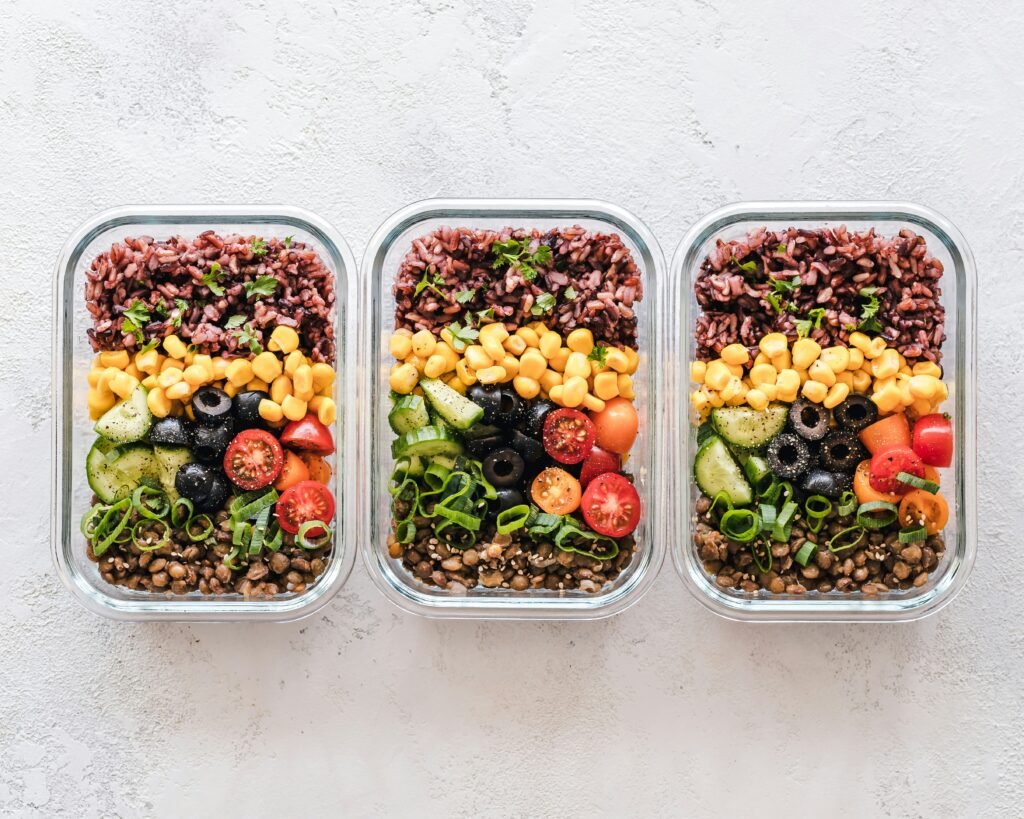
Once your batches are cooked, split them straight into individual containers sized to your meals. On a 12-hour shift or a day packed with meetings, you want to grab something and go rather than standing in the kitchen weighing out portions at 7am.
Step 5: Keep 3–5 quick meals in reserve
FAQs
How long can I keep 75 Hard batch-cooked meals in the fridge?
The Food Standards Agency recommends eating refrigerated leftovers within 2 days, and cooked meat dishes within 3 days. Cool everything within 2 hours of cooking first.
Can I freeze my 75 Hard meal prep to save time during the week?
Yes. Freezing pauses bacterial growth almost entirely. Freeze within 1-2 hours of cooking, and once defrosted, ideally in the fridge, use it within 24 hours.
Does meal planning actually help you stick to a diet?
A 2017 cohort study of over 40,000 adults found meal planners had better diet quality and lower obesity rates than non-planners, though this shows a link rather than direct cause and effect.
How much time do people actually spend cooking each day?
UK data shows a median of 50 minutes a day for women and 10 minutes for men. Batching that time into one weekly session is exactly why this system works for time-poor people.
To go deeper on what to actually eat across the full 75 days, the 75 Hard Meals: The Definitive Guide You Need is the place to start. And if a weekly 75 hard meal prep system is what you’ve been missing, this is the missing piece that makes the rest of the programme sustainable.
References
- UK Time-Use Survey cooking analysis · 2015 · Appetite (PMC) · https://pmc.ncbi.nlm.nih.gov/articles/PMC4509715/
- Ducrot et al. · 2017 · “Meal planning is associated with food variety, diet quality and body weight status” · https://link.springer.com/article/10.1186/s12966-017-0461-7
- Food Standards Agency · current guidance · “How to chill, freeze and defrost food safely” ·https://www.food.gov.uk/safety-hygiene/how-to-chill-freeze-and-defrost-food-safely